

explorations & endings
time & shapes from a year gone by
Look at that, the year is coming to an end. I’d like to say thank you for partaking in little cups of my brew- reading, commenting, replying.
Do you feel like 2025 has rushed by, are you in the “what- its almost 2026?!” camp? Or does it feel about right, how the months have cruised by, now coming to gentle end? Time is elastic that way, the same units can feel different for two of us.
I sometimes think of that wonderfully telling phrase, “the days are long but the years are short.” Often said in the context of parenting, I find it can give pause to most- in how we look at our daily lives, and the arc of our time on this planet.
I think of it, but not for long enough.
This year, I sent out 30-something dispatches, each with a ‘feature’ piece, a creative curation and another piece of commentary or perspective, plus the ever-present Masala Peanuts. I started accompanying each post with an audio of me reading it aloud, for those who prefer to listen (or are just ace multitaskers); and I created some videos ( I enjoy these and have got some cool feedback, but am not doing as many as I would like).
I often found myself sucked in way more than I expect, when looking up a story. Though that’s the fun, I definitely grapple with balancing that with the rest of… life. But, I still look back on many with a lingering sense of wonder or fascination.

Time, form, bridges.
I could say my Coffee & Conversation meanderings are carefully shaped and deeply contemplated. I could, but I won’t, because the truth is I haven’t set out with prescribed themes. At least, nothing more than the overarching premise that this is “eclectic storytelling around culture, creativity, humanity & tech.”
Now though, as I indulgently cast an eye on the year gone by (because, of course, like any publication of great note and import, I should do a lookback), I am tempted to spot threads that run through my writing.
Time and form seem the most apparent- recurring layers, across themes.
The C&C description says, “I like odd & beautiful & dark & funny things.” So it is not unsurprising that form is a recurrent theme; the shape of things- frames, formats, styles, craft, structure, the way meaning is designed.
Like when recalling the old Hipstamatic app prompted my dive into a visual aesthetic for the ages. Square is the new Black explored (in two parts!) the square format’s evolution- a visual constraint that morphed into artistic language across Polaroid and Instagram.
Or how form influences experience- Craft in the Ordinary looked at the physicality of crafted objects like handmade keyboards, that exist via a different lens- function, but also presence.
Form also circled themes of popular storytelling and reinterpretation. Don’t Judge a Book By Its Author found Jane Austen in TikTok culture- classic literature being reshaped by new readers, new visual cues.
Wading through mid-century cartoons from India showed how humour and national imagination were shaped by visual limitation and simplicity. In that sense, form can be a prism to understand culture.
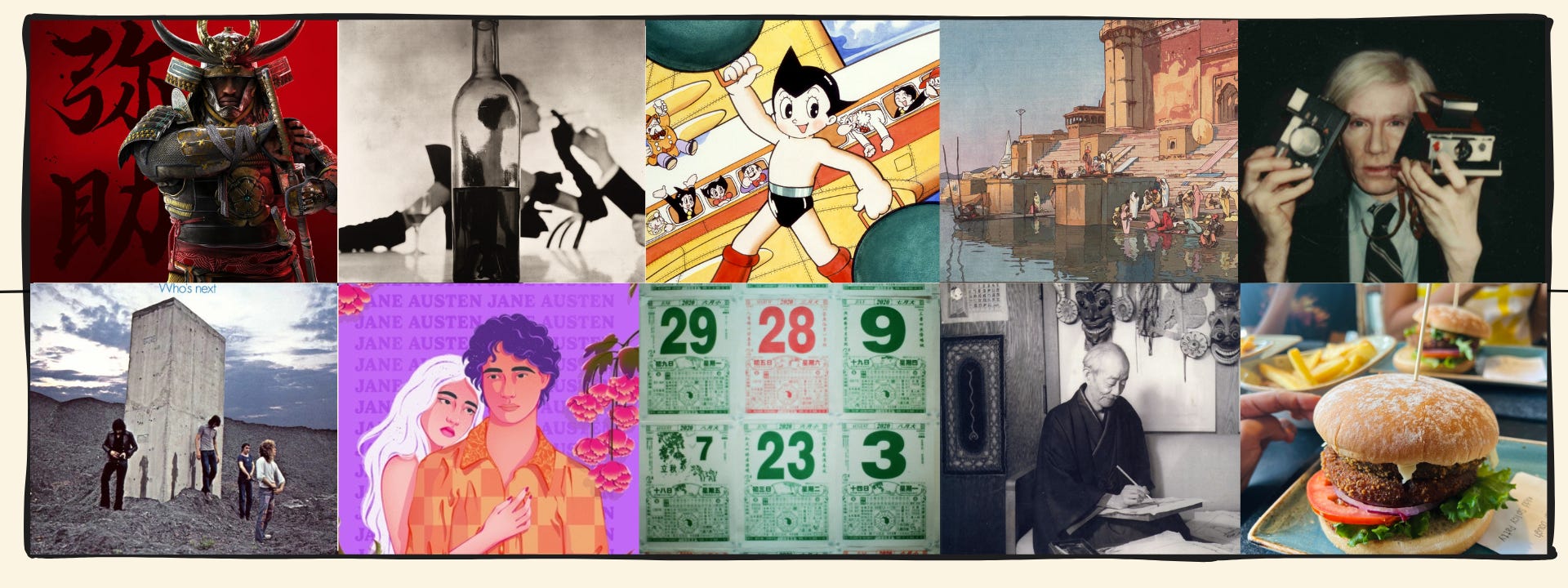
The pull toward time and form also shaped pieces in pop culture.
The Last Portrait looked at John Lennon and Yoko Ono’s image as a moment where art, intimacy and tragedy froze together to become cultural memory. Osamu Tezuka’s Astro Boy appeared through a mundane, delightful connection (my mug!), linking back to a 1950s manga throwing up questions about robotics & ethics which still echo across the generations.
Across the newsletter, ideas travelled between centuries in unexpected ways. Time filters nostalgia, of course. But I enjoy how time can be both distance and bridge.
In Light as a Living Thing, Japanese artist Hiroshi Yoshida’s paintings of India in soft pastels in the 1930s, suddenly felt comfortably serene on social feeds, ninety years later.
Teenage Wasteland connected a mid-20th century Indian spiritual master, a dystopian future, and Stranger Things… courtesy The Who. An SNL retrospective squeezed a lifetime of performances into one sequence- it was editing as time travel. Dire Straits’ MTV anthem and that guitar riff revealed a story that had hovered on my edges for years.
(As you can see, I was happy with music threading through time.)
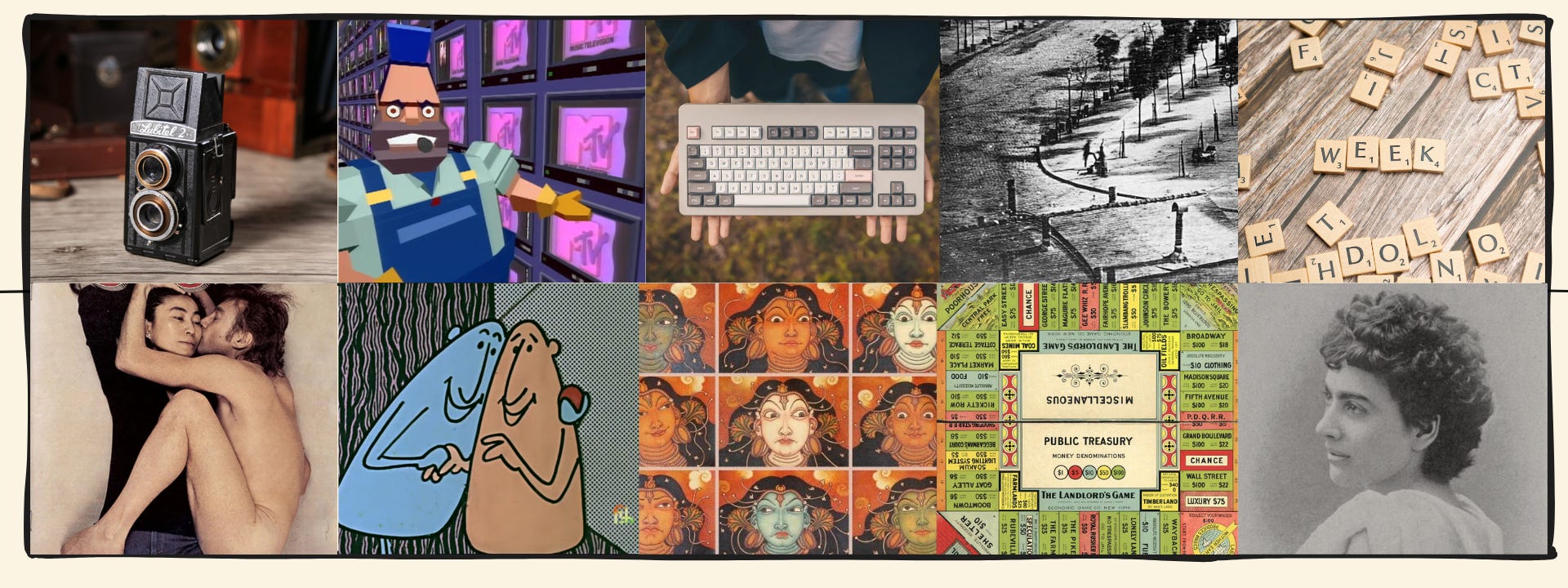
There were bridges too, between today’s culture and some long, twisting roots.
I spotted creative freedom advocated in an ancient text: “there is no wise maxim, no art or craft… not found in drama”- ancient creative expression echoed across millennia via the Natya Shastra.
The Unlikely Samurai, “a gaijin whose story reaches out across the centuries,” found Yasuke- an African in Japan whose identity has remained half-myth, now at the centre of a major game franchise.
The story of Monopoly spied the game that began as an anti-capitalist critique by Lizzie Magie, before being swallowed by capitalism itself, pushing its inventor into the margins.
Indeed, stories from the margins held allure- the first photograph to ever capture humans; a stranger on a beach talking about the didgeridoo (Yidaki!); modern calendars and the names of our weekdays; or the ‘missing days’ of 1582, hinting at how notions of time can be slippery, and how thin the line is between history and myth, neutrality and invention.
Others arrived simply because they felt alive in the moment- the slow magic of Test cricket; the veg burger I grew up with; a look at the term ‘Ma’ across the world, specifically its philosophical meaning in Japan.
Of course, the patterns emerged after stepping away from the work and seeing it as a whole, I didn’t quite chase these themes intentionally. I did follow curiosity toward how things come to be, why they look the way they do, how ideas age, how culture mutates, why certain stories feel worth slowing down for.
I suppose they reiterate an underlying belief that humans are endlessly creative- we move, often deliberately, sometimes bumping along. We use, abuse, shape and sometimes ignore form & craft, tell and retell stories, leave trails and ideas for the ages, to be celebrated, discovered, debated and toyed with by itinerant writers.

Curations Wrap
If essays shape this newsletter, curations are the soundtrack- little jolts of visual delight. These showed up, stopped the scroll, and felt worth sharing.
There are always pieces I love simply for mood and vibe.
A Dance in Dakar was all salt air and youth by the Atlantic, the languid ebbs & flows of youth in summer. Max Richter’s gutting track On the Nature of Daylight is set to a woman moving through ordinary streets. It lingers long after.
I often lean toward craft and aesthetic.
Nilaya Anthology was a slow visual poem you just let wash over you. School’s Back was a riot of student-led creativity in one ambitious shot. And See It Differently was pure craft worship: one actor, 11 sets, 50 crew- effort as entertainment.
The human tissue of culture or personal connection will also get me.
Mother, Creator charted two decades of a mother and son shaping life together, while A Cop & His Mother turned a son’s childhood dream into art. Guinness’s A Lovely Day reimagined the brand as a neighbour across 50 U.S. states, riding on its “core belief in human goodness and the power of communion.” Adidas’ You Got This celebrated the support systems around athletes- coaches, parents, friends- rather than the lone hero. There was a dose of optimism and cuteness from eight young French schoolgirls.
But always, the odd and amusing: Indonesian ghosts cleaning up their act in Scary Good; Channel 4’s Sorry Not Sorry doubling down on identity and sarcasm; One Tight Slap’s bizarre mockumentary hilarity.
And Is This a Good Time?, with its us ever-so-polite tap-taps of existential angst.
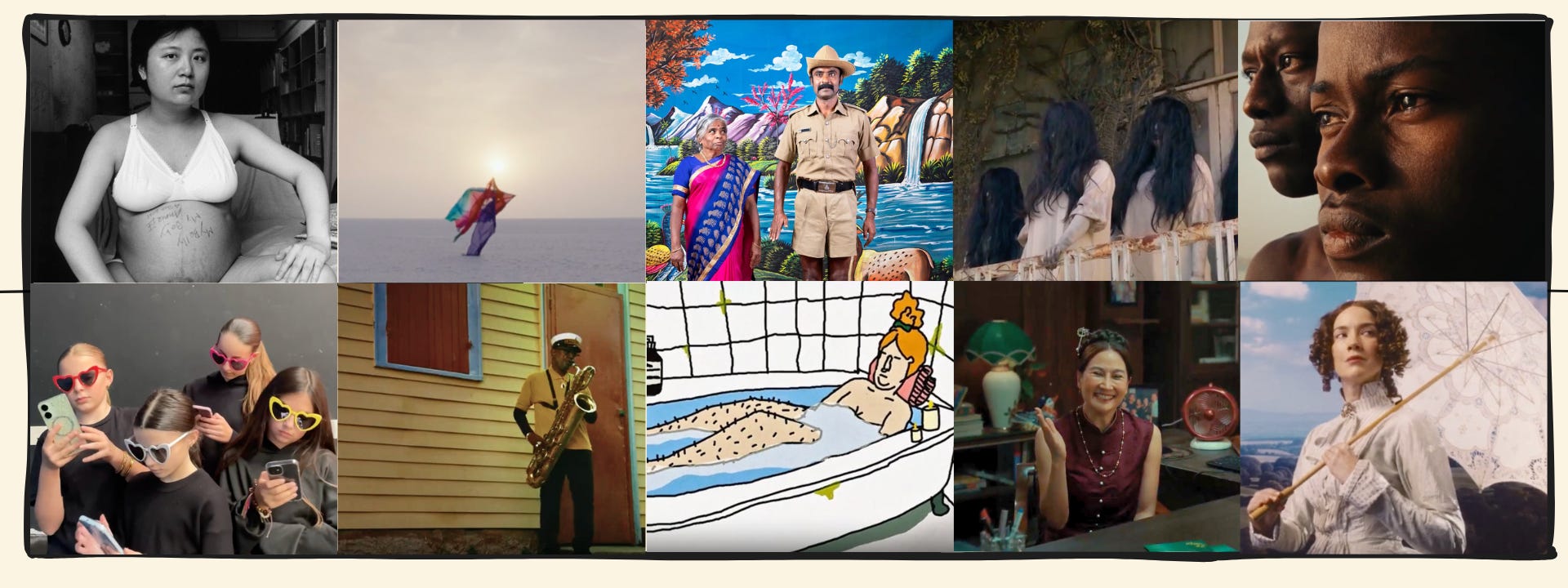
A selection of things that felt alive- craft, vibes, stories, and oddities. Culture & creativity is wide, messy, playful, and everywhere.
Coffee & Conversations is happiest wandering through it.

I hope the year is winding down well for you and yours… here’s wishing us more wonder, smiles, queries, ideas, and humanity in the new year. With, of course, quality coffee and other beverages of choice.
If you’re enjoying these meanders through creativity and culture, you can buy me a coffee ☕ — it keeps these wanderings going. And if you think you know others who will enjoy some of these explorations and this storytelling, please- share it along!