

From pitches & beaches
Test cricket, music history lessons, human jingles.
🎧 Prefer to listen? Hit play above to hear this in my dulcet tones.
Hello there, kind people. Welcome to another of my dabbles in culture and expression. Thank you for having me in your inbox/feed, I appreciate it. Here are today’s fresh brews.
Yidaki: History lessons on a beach.
Friday Find: a warm piece with fuzzy roots.
Tested: a little indulgence, on what Test cricket can be.
With: ancient chambers, broken online empathy, watermelon bags?

1. Yidaki
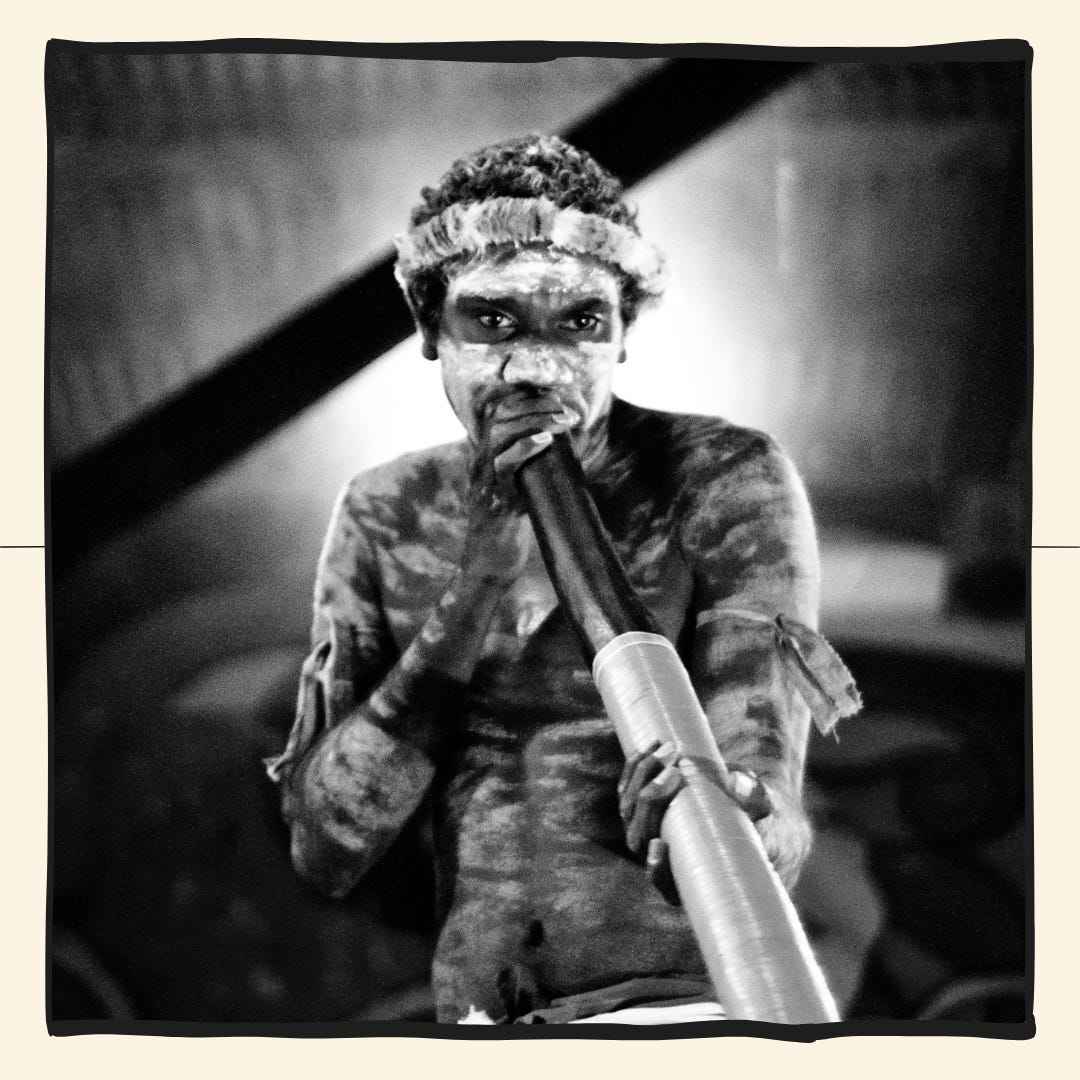
Two weekends ago, I was at the beach. As we walked off the sand, clutching our flip-flops and mat and spades, I spied a tall man striding down the paved pathway, a shorter friend in tow. He carried on his shoulder a rather large wooden item, like a misshapen pole. We happened to almost intersect, the eyes met. I smiled and said, “Didgeridoo?”
He stopped, a tad dramatically. Rolled his eyes, took a deep breath. Then, with an air of studied exasperation and indulgent instruction, he proceeded to tell me I was wrong. Deeply, fundamentally wrong. My life had been led down a path of blatant misinformation to this very moment when I was fortunate enough to meet him, perchance.
Wait, what.
European settlers came to Australia in 1788. Indigenous Peoples had been living on the continent for tens of thousands of years. One of their many musical tools was a traditional wind instrument from the northern part of the continent- the hollowed-out trunk of a tree. Sounds were produced by blowing into this trunk through the attached beeswax mouthpiece.
Like much on the continent, there was no one singular instrument of the kind, nor one name… and definitely none that were known to the settlers. In time, it is thought, a word emerged attempting to mimic the instrument's unique sound. This onomatopoeic term was to be used by the English-speaking Europeans, and then the world at large (onomatopoeia, the formation of a word from a sound associated with what is named, eg, cuckoo).
Didgeridoo.
Its first known appearance was in 1919, in the Australian National Dictionary (though a similar term is found to be used nearly a century earlier, “didoggerry whoan”). The word has since been widely accepted in the English language. For the indigenous peoples though, there was no such thing.
Yidaki, also sometimes spelt yirdaki, refers to the specific type of instrument made and used by the Yolngu people of north-east Arnhem Land.
My happenstance instructor impressed upon me the inalienable truth that his instrument- and all such- was, in fact, a yidaki. What’s more, didgeridoo was not only a colonial term, but a symbol of a racist colonial mindset, because it actually came from Gaelic roots, and meant ‘black blower’ or ‘spitter’.
The truth, as the world relentlessly impresses upon me, is a bit more nuanced.
The Gaelic origin theory for the word, was floated around 2002 by a PhD student in Adelaide. She believed the word derives “from the Irish and Scottish Gaelic term dudaire, pronounced dooderreh or doodjerra and means a pipe smoker, a nosey person or a trumpeter or horn blower. The Gaelic term for black is dubh, pronounced duv or do. In combination, the terms produce doodjerra doo.” The theory gathered some momentum, being the kind the internet likes, but it would appear also the kind that eventually doesn’t have too many academic takers.
Indeed, even the term Yidaki can by no means be called the ‘actual’ name of the didgeridoo. Aboriginal Australia is made up of many language groups, and there are different Aboriginal names for what is now commonly referred to as didjeridu. Musicologist Alice Moyle wrote that there are “almost as many names for the instrument, as there are identifiable language groups” who use it. Some say there are over 45 distinct Aboriginal language names. Consider “mago” (West Arnhem Land), “ilpirra” (Alice Springs), and “bambu” (Adelaide River).
‘Yidaki’, we are told, is to be specifically used for the version made and played by Yolngu people, often for ceremonial use and with distinctive acoustic and structural characteristics. Indeed, calling any ‘ol didgeridoo a Yidaki could be considered disrespectful. Most Aboriginal people recognise that the English term is a generic one. “When speaking in English, a Yolŋu man may ask that you pass him the didjeridu, pointing to a locally made yidaki. Yolŋu have been taught that “didjeridu” is the English word for the yidaki, so they will use it when speaking in English just as they would use other words like “tree” or “water.”
So, my dear musician stranger, thank you for the little rabbit hole you opened up. I don’t doubt you play the Yidaki, and I am equally certain I will never be able to tell the difference if you didn’t. But next time, I might just ask first.
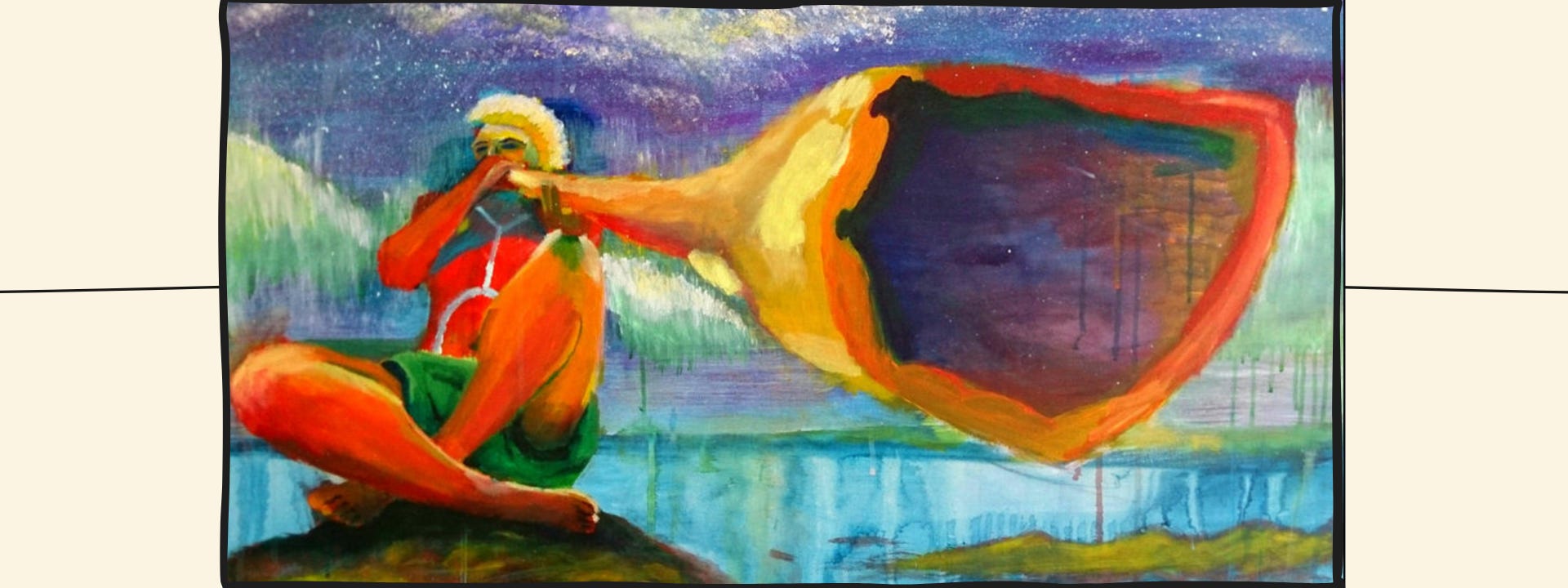
*“Well, it looks like a yidaki, and sounds like a yidaki, but we don’t know how it’s made…. maybe it’s something different.” _*Wukuṉ Wanambi Marrakulu clan leader
· Irish, is it? · Not quite Gaelic · Essay and exhibition review · Are yidaki & didjeridu the same? ·

2. Friday Find: being human
If you’re human and you know it…watch this spot?
‘World’ from Tools for Humanity launched a first-ever ad spot for human verification in an AI world.
What?
Just watch first.
So.
World.org is intended to couple secure human identity with ‘inclusive’ digital finance. Built on blockchain, it’s a cryptocurrency and identity verification project, with Sam Altman as one of its founders. Maybe some alarm bells are ringing, or a switch has flicked off when you read that, and I hear you.
Be that as it may, I thought the spot was wonderfully evocative and speaks well to one of the central questions marks of our time. If it is meant to feel warm and fuzzy and trustworthy and very human, methinks it does a good job.
The spot promotes the ‘Orb’ device, which is what it used to verify users as real humans. It has over 27 million users globally. You could go on to figuring out what it really is, if you wish. Or smile and wave on.
Here’s some of the spiel, if interested.
“World is a network of real humans, built on anonymous proof of human technology and powered by a globally inclusive financial network that enables the free flow of digital assets for all. It is built to connect, empower and be owned by everyone. An anonymous way to prove they are human online in a world where intelligence is no longer a discriminator between people and AI.”
· Directed by Jim Jenkins · O Positive · Arcade Edit ·BBDO New York

3. Tested
In a time of instant gratification, it is an anomaly. Sometimes akin to a quiet unobtrusive lurker in the corner, keeping its place as the world chooses to hurtle by. Other times, a roaring rebellion of the considered and the deliberate, a proud bearer of the ploddingly fantastic, the seepingly spectacular.
This is Test cricket.
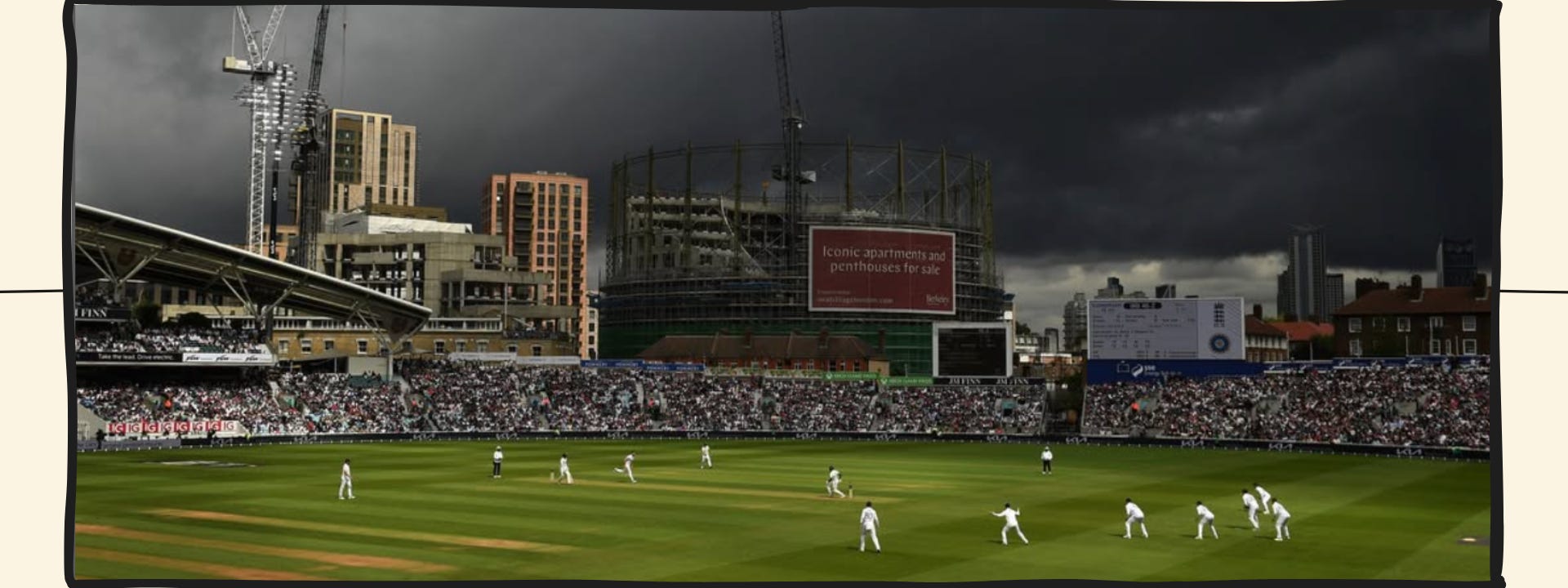
For many this week, its all about last Monday morning in London, afternoon/evening and wherever else you might have been. “56 minutes of hell. 56 minutes of heaven,” it has been called, when India snatched a famous win from under the home side’s noses. And yes- that morning was a crush of all that Test cricket is about or can be, swirled like a vortex into less than an hour.
But that hour was nothing without the four days before it, or the 20 before those, spread across a gruelling, gorgeous, gut-wrenching, glorious six weeks.
There are those who find such emotion befuddling, such attempts at eloquence disproportionate; some who feel this is a storm in the English teacup; juvenile tribal hearts roaring for mere sport.
I agree. This is just sport. Just 22 men playing with a simple leather ball and a plank of wood. In the same sense we could also ask— isn’t everything, merely just what it is?
In actual fact, so much of what we do and enjoy is more than ‘merely itself’. It is elevated, it elevates. As does the finest Test cricket— immersed in such deep challenges of body and mind and heart and, dare I say it, soul.
Every sports fan believes there is something unique about the game they follow, but Test cricket is surely peculiar in its premise. Two teams play for up to five days, it being entirely possible that neither emerges victorious. The reward comes from its ebbs and flows; the meaning sometimes camouflaged in the slow burn of effort and ideas. The search is not for a brief transcendental spark that defines it all. Instead, the exploration builds increments of inspiration, layer upon layer of skill, drizzled with precious droplets of belief.
Nothing is merely itself. Everything is more than itself.
This game flies in the face of our times, our seemingly incessant swirl of clamour. A world struggling to give time to the slow, the considered, the uncertain. With attention being dragged this way, then that, then another… who can take a breath, indeed many breaths, for the triviality of a mere game?
This week we saw that those 22 men can. The legions that follow them, can. Their time rewarded not just with results, but persistently unfathomable ideas of what it means to search, to strive, to do, to delight, to belong, to believe.
In times when we most frequently talk of what is real, what is efficient, what is quick, what is productive, this old warrior—Test cricket— raises a head and gazes unwaveringly. Even in his most effervescent, glorious, incandescent, visceral of moments, he surveys the scene slowly, smiles knowingly, and take a deep, long, breath.

Shoutout
I also write The Colour Bar, a weekly dispatch on media, entertainment, brands, content, creativity and tech. This week, for example, there’s a profane Samuel L Jackson double bill, if that’s your thing. Have a look- many of you might find it interesting.
Masala Peanuts
(where I share stories or tidbits I find interesting).
Broken online empathy: “the flood of digital content doesn’t allow room for pause – only reaction”. A short but insightful piece on how much our actions and reactions in the digital world are performative, as we leave a ‘like’ to signal mere acknowledgment of the most crushing of news & stories.
Niche products anyone? A belt for carrying skipping stones… or pouch for a wine glass… or… a bag for a watermelon?? Yes, these are from Japan and look ludicrous and gorgeous, at once.
India's mysterious ‘dwarf' chambers’. Ancient megalithic chambers dot this "Hill of the Dwarfs" in Karnataka. Locals believe they were created by a supernatural race of "small people".

Add To Queue
-watchlist, playlist, readlist-
Andor, which was eventually watched. Yes, its a ‘Star Wars’ show, but a fine show without that baggage. And there’s not a lightsaber in sight.
