

Let's Talk About Love.
Bird poems, Roman deaths and naked nobility ; Coldplay and ghosts and Nike; enjoying the unknown.
Shakey Omnes Salutem.
Is today a special day of some sort? For many, yes. Special enough to write about? Definitely curious enough to!
Lets Talk About Love: Because it is always the answer.
Friday Finds: Asian ghosts clean up their act.
Coldplay ♥️ SG: The biggest (smiliest) band tells a story with Singapore.
We Have No Control: On randomness in an interconnected world.
With: A new section & new football; a drive around with young icons; a legal loss for AI, and a confession on Tiktok.
1. Let’s Talk About Love. Baby.
Third century Rome. A Catholic priest defies the Romans, secretly performing marriages for young soldiers. His subversions lands him in prison, where he writes letters before being summarily executed.
In another Rome, in a not a very different time, exists Lupercalia. A chaotic festival featuring naked young noblemen who run through streets whipping women with goat-hide strips. Women line up for this, believing it brings fertility. The Church watches this pagan celebration with distaste, plotting its transformation.
Fast forward a millennia. An English poet who will be remembered for centuries to come, pens a long poem about birds congregating. A poem that becomes wildly popular in literature and medieval courts, forever changing how people think about a particular February day.
We stand centuries from the priest and medieval scribes and naked noblemen, yet today we feel their tug through a strange thread; woven with them, but not of their making.
Wishes, then, for the most commercially successful celebration of love in human history: Happy Valentine's Day.
Martyrdom to Marketing
That rebellious priest became a Saint. You got it, Saint Valentine. Except, he was one of three different Saint Valentines. One was a priest in Rome, another a bishop in Terni, the third evangelised in Africa. All martyred by the Romans and none particularly romantic; they were remembered for their devotion to the faith, not matters of the heart. But surely, we can set aside such trivial details.
Back to the priest in Rome. His execution was slated for February 14. A judgement famous enough to have many versions. In one, he's martyred for secretly marrying Christian couples (Emperor Claudius II banned marriage because he thought unmarried men made better soldiers). In another, he's killed for helping Christians escape Roman prisons. Other accounts claim the Emperor actually liked Valentine, but ordering his end when the priest tried to convert him to Christianity.
Only two consistent elements have sustained— consistent, but entirely unverified. The date, and a final letter to his jailer's daughter. He is said to have written to the young woman— who he had healed of blindness, no less— a farewell note signed "your Valentine"; a letter with no known romantic overtones and one which, conveniently, no one has ever found. It became the unlikely seed of a tradition that would bloom for hundreds of years.
As for Lupercalia, the Church's solution was elegant: replace the naked running and ritualistic whipping with a more modest Christian feast day— Saint Valentine's Day. The transformation wasn't immediate, but over centuries, the wild fertility festival evolved into something more palatable for medieval sensibilities.
Words of Love
The medieval poet was Geoffrey Chaucer, and his poem ‘Parliament of Fowls’ did something extraordinary: it linked, for the first time, the Saint Valentine's day with courtly love. The poem described a dream vision where birds gather to choose their mates, featuring a debate among eagles vying for a female's attention.
‘For this was on seynt Valentynes day, Whan every foul cometh there to chese his make’ or
For this was on Saint Valentine’s Day, When every fowl comes to choose his mate.
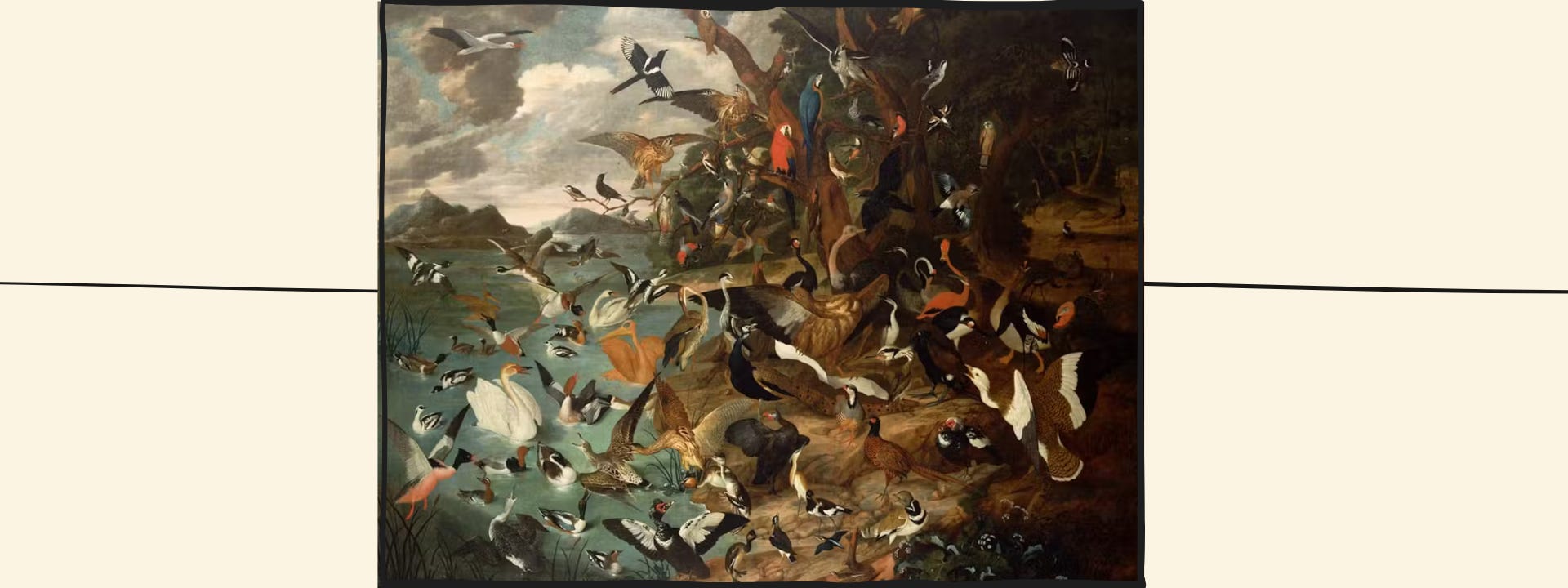
Thank him or blame him— before Chaucer, nobody associated the day with love. Written circa 1375, his poem gives us the first known connection between this feast day and romance. Except, there's an auld twist— we don’t really know if he meant February 14 at all! Chaucer might have been referring to May 2 (the feast day of Valentine of Genoa), since birds typically mate in spring, not in the English winter. (This aligns with another theory- the signing of a treaty on May 2nd, 1381 marked the engagement of King Richard II and Anne of Bohemia—a possible inspiration for Chaucer's poem)
Again, a mere technicality that true romantics needn’t bother with.
The associations snowballed. His 699-line poem on avian mating sparked a cultural revolution in how Europeans celebrated the date. Suddenly, nobility began exchanging love notes on February 14, creating the first ‘Valentines.’ Other poets loved it, reinforcing the association over the years.
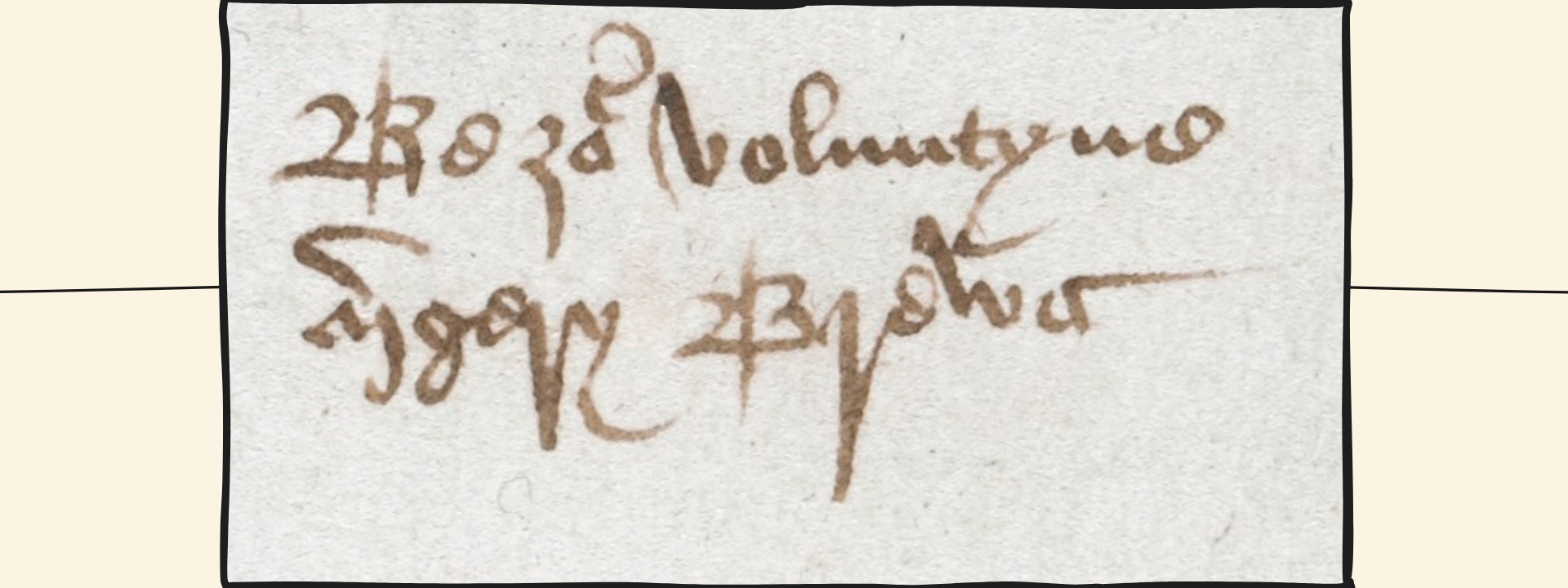
The earliest known Valentine letter in English was written by one Margery Brews to her fiancé, one John Paston, in 1477. She called him “my right well-beloved Valentine” in a missive now housed in the British Library. Aside: Margery had also written another letter to her “dearly beloved valentine”, ending with, “I beg you that you will not let anyone on Earth see this letter, except yourself”.
Ah, Margery. There’s this thing called the internet coming about 500 years from now…
Shaping Love
Marketing premise done, some branding was needed. But the great heart shape that surrounds us now like red spew, was not always a symbol of love.
For that evolution we must look at ancient cultures. A heart-shaped pendant from the Indus Valley Civilisation (3300-1300 BCE); or 5th century Cyrene (present-day Libya), where the now-extinct silphium plant, used most notably as a form of birth control, it’s seedpod closely resembling the modern heart symbol.
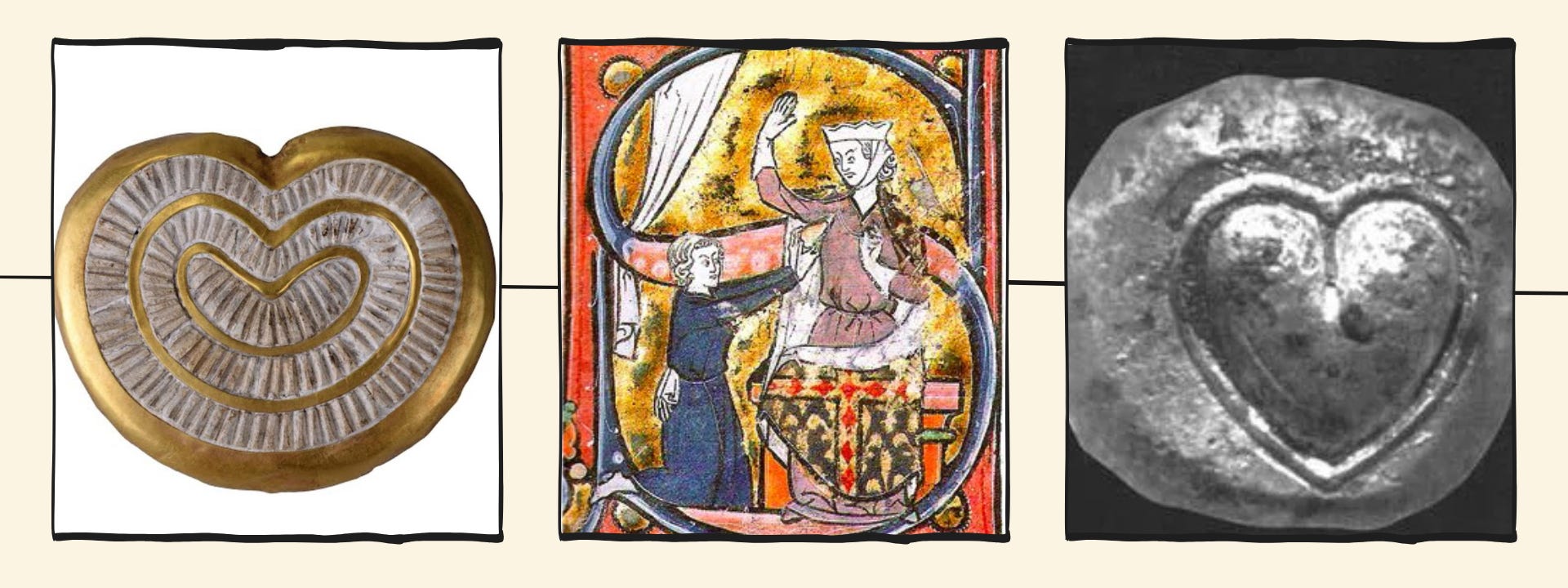
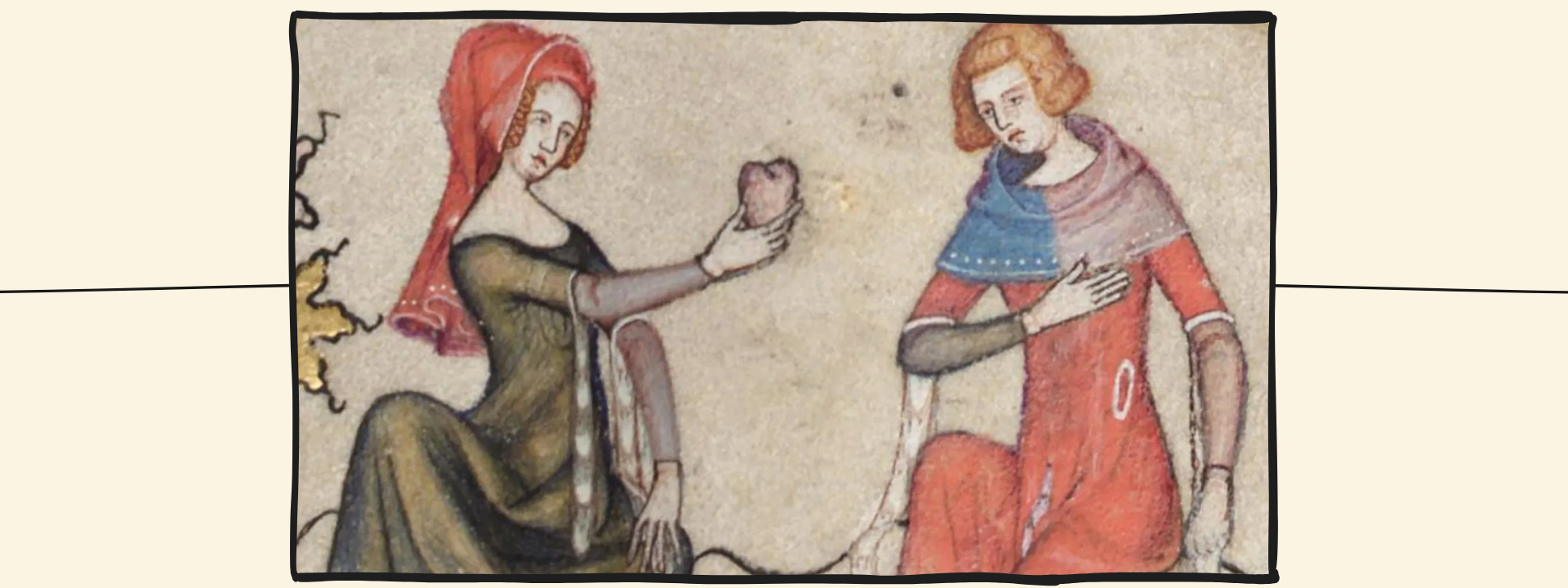
The first known depiction of a heart as a symbol of love dates to the 1250s in a French manuscript ‘Roman de la poire’. Then, ‘The Heart Offering’ from 1338-44 is considered the first actual representation of romantic love using the heart symbol as we know it today, though it doesn’t look like much, really (below). These were rare though; and the liberal use of the symbol in the influential ‘Documenti d'Amore" (Documents of Love, early 14th century) was not for romance, but as a mnemonic device to remember teachings on virtue, courtly behaviour, and moral living. But no love, fellas.
By the 15th century, playing cards had helped standardise the heart symbol we know today, and it gradually became associated with romantic and physical love rather than spiritual devotion. Valentine's Day didn't adopt the heart symbol until much later– around the 18-19th century, when printers began using it on cards and love notes. This is when expressing one's feelings became an art form. Literally— the Victorians gave us the first mass-produced Valentine's cards.
Caustic Counterparts
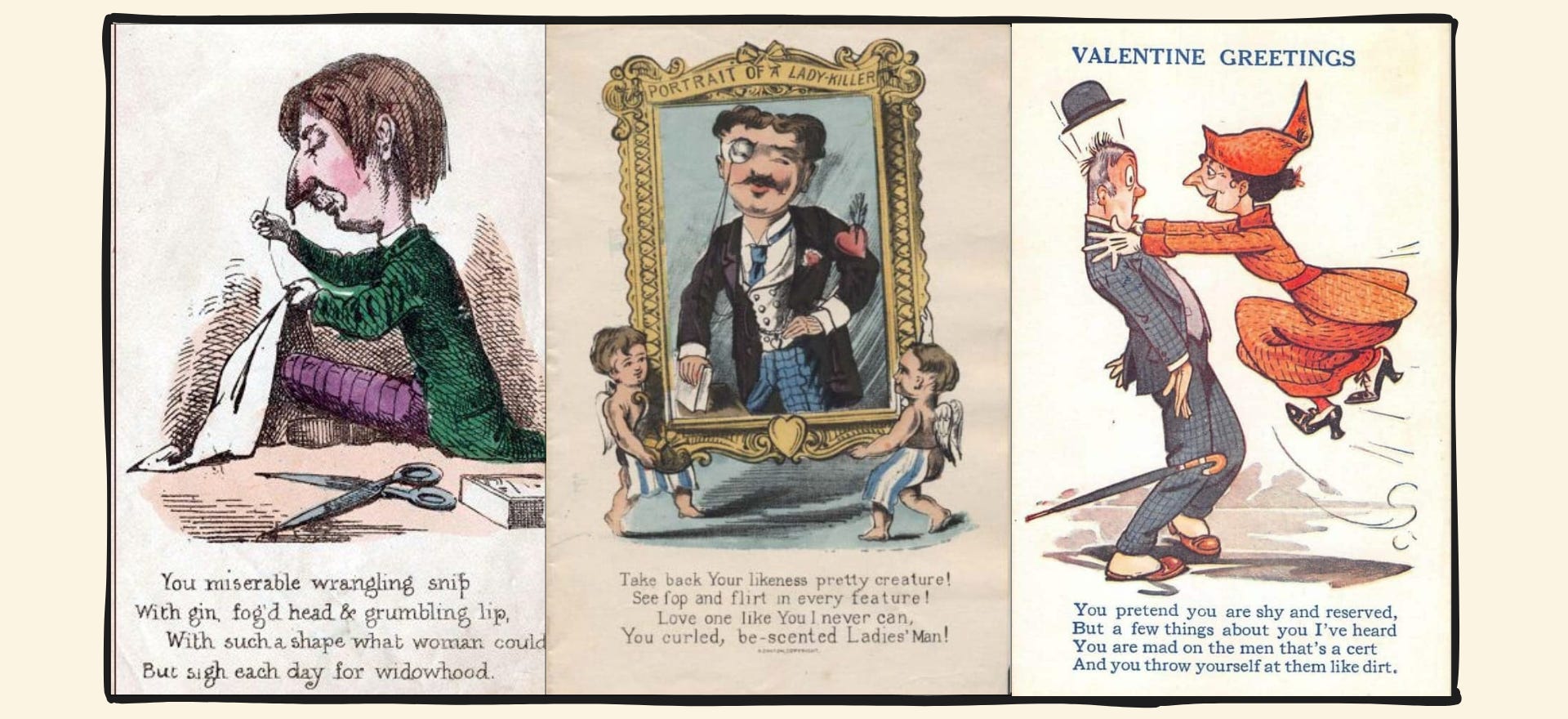
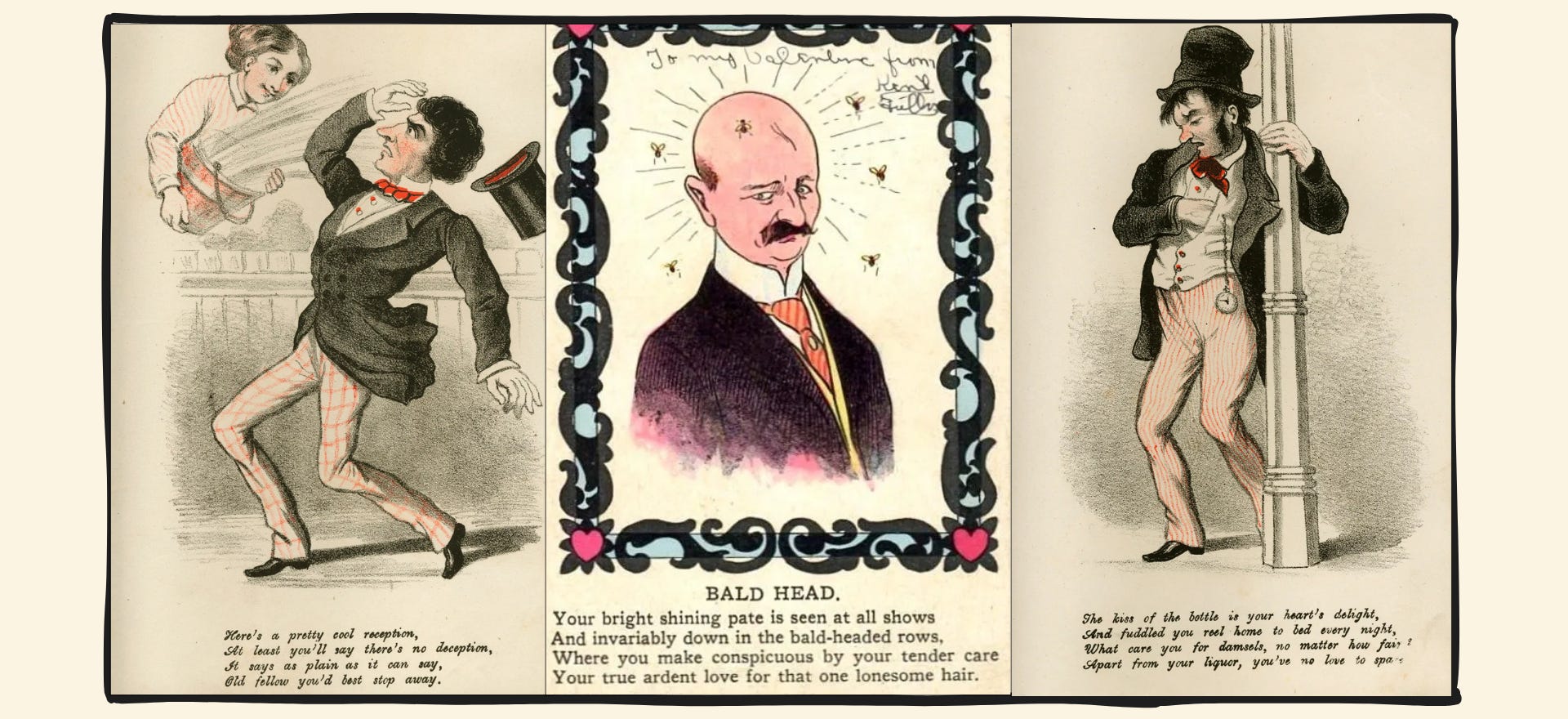
A worthy detour: those times of passive-aggressive communication gave us both elaborate romantic valentines, and their evil twins: Vinegar Valentines. These caustic cards were a socially sanctioned way to anonymously criticise someone's appearance, personality, or behaviour; cards specifically designed to insult people, from unrequited loves to annoying neighbours. Sharp, sarcastic, often hurtful, they were surprisingly popular– comprising up to half of all valentine sales in the 1840s!
When love is in the air, spite can’t be far off.
The Commerce of Love
The Victorian era's embrace of Valentine's Day set the template for our modern celebrations. They established the tradition of mass-produced cards, an emphasis on anonymity and mystery, the inclusion of poems and verses, symbols we still use: hearts, flowers, cupids, and lace… all coming together for a blockbuster mix of sentiment and commerce.
Printing technology made cards cheaper, the practice spread across social classes, across continents; chocolate companies like Cadbury jumped on the choo choo train— they get credit for the first heart-shaped box of chocolates, in 1861.
The Victorians created a commercial blueprint that would evolve into today's multi-billion dollar industry. Globally, roughly 59% of consumers celebrate Valentine's Day. In 2025, US consumers will spend an estimated $27B, while over in India the market is valued at approximately #3B; as much as 20% of annual Japanese chocolate consumption happens around now; in the Philippines, mass weddings on Valentine's Day are common; and while Saudi Arabia banned the sale of all things red on Valentine's Day for many year— creating a black market for roses and heart-shaped chocolates— things have eased off, and it is celebrated openly now.
Not a capitalist sham at all. This is true love.
From Couples to Everyone
Modern Valentine's Day has expanded from celebrating romantic love to embracing all forms of affection. Today, the celebration has splintered into multiple interpretations across cultures. Galentine's Day (Feb 13) celebrates female friendships; Singles Awareness Day (Feb 15)— the initials are completely unintentional— embraces those flying solo; even children's classrooms have exchanges.
Growing up, I was occasionally caught up in the V-Day swell of love, but grew to become a bit disenchanted by it. Not for any moral reason, nor because I had no one to spend it with (!), but just because I found it often crass and shallow, weighed down by crafted expectation. To be clear, I am not anti-Valentine’s day, nor would I prefer it to be cow hugging or Mother-Father Day (as the Indian government has laughably tried). It’s an opportunity to show your love, and that mostly can’t be a bad thing.
Like with much else, this global shared culture is a coming together of chance, clever connections, cupid and commerce. Be cynical, or let the love flow, or simply shrug it away— the choice is ours.
Whatever you do, just spare a thought for the imprisoned Saint… and those birds.
· ~ ·
More reading
· The connection was invented, probably by poets · The heart shape, traced & traced · The human heart & love · Saudi Arabia celebrates · Cow-hug day · Mother-Father Day·
2. Friday Finds: Scary good!
Indonesian ghosts clean up their act. Kuntinalaks or Pontianacs, Pocongs and shivering zombies in this far-out hilarious spot from Indonesia. Watch it without knowing the product.
What a freaky way to channel horror tropes that are incredibly popular across the region, blended in with random humour and a fearless brand approach. Great fun!
· Production: Factory01 · Director: Wuthisak Anarnkaporn · Mullen Lowe Lintas for Lifebuoy Indonesia.
~ · ~
So Win.
After 27 years, Nike decided to advertise in the Super Bowl. Their travails in the last year or more have been well-documented, and as they look to bring back the brand love, the halo (and the retail), they could do worse than combining powerhouse athletes with powerful script read by a Grammy winning rapper, driven by a Led Zeppelin track.
3. Coldplay ♥️ SG
Coldplay just dropped a music video set in this island nation, and in many ways, it’s probably just how you’d expect it to be. But that doesn’t mean it’s not a good one!
The fresh MV for Man In The Moon from the extended album Moon Music, is filmed around iconic locations in SG, with the band on a floating stage in Marina Bay- “It was really fun to have a kind of dance party out in the middle of the water, just us and the otters”. Even if you didn’t know it was done in collaboration with the STB, you’d probably guess it while watching.
And yet— despite its ‘expected-ness’ and very apparent showcasing of Singapore— it’s not a grating partnership. It’s a pretty fine example of destination marketing wrapped in some great feel-good vibes and a desire to craft a slightly different narrative. For starters, the lyrics just fit in so much
We were born to be/ Young and free // We were born to be / Family.
Coldplay is Coldplay- their joy, positivity, and warmth flow through. And Singapore is Singapore too, but beyond the landmarks, maybe not quite how many might perceive it. Strip away the cliches of clinical, boring, or uniform that often plague Singapore’s persona; show how it is much more than that. This is a worthy effort to peel away stereotypes; bold visuals are needed to shake off those lazy cliches, and here that comes from the casting. It’s not just the age. Sure, the cast is young (that’s expected), but there is a concerted effort to include diverse profiles that radiate a creative and- dare I say- even slightly rebellious energy. (I can imagine the words ‘edgy’, ‘cool’, ‘alternative’, and ‘creative’ bouncing around in brainstorming meetings).
Most importantly, you need strong vehicles to shake off lazy cliches— what better than the runaway train that is the biggest band on the planet?
4. We have no control.
“The worst moments of your life are inextricably linked to the best moments of your life,… the good and bads of our life end up creating future joy and future pain, and we can't do anything about that.”
Life is full of randomness. Things happen out of nowhere, ideas appear unheeded, changes come unbidden; little things lead to big things, significant moments are explained by trivial ones. Most of us overestimate the amount of control we have in our lives, and underestimate the value of little things. Little things that set off events in motion no one can predict. In an interconnected world, the smallest of human choices can lead to unexpected, unwanted, problematic or delightful effects.
A podcast from The Hidden Brain I listened to this week looks at much of this, woven around fascinating anecdotes, ranging from the atomic bomb to dinosaurs, a beach ball to chaos theory. It encourages us to think about both the little things while acknowledging the big, and why the need for resilience is so important. (linked ahead)
I found myself thinking about the larger view, where communities, organisations, corporations tend to be so consumed in the immediate they don’t see the long effect; while somehow still not being able to heed the import of the everyday. And how the relentless pursuit of productivity and efficiency can, in fact, erode our resilience.
Our failure to recognise that our world is saturated with randomness comes with great costs. We expect order and predictability to prevail and then get blindsided by sudden crises. We like to imagine that we live in an orderly universe that is occasionally upended by an unexpected event. But what if those unforeseeable occurrences are the rule, not the exception?
5. New Balls Please?
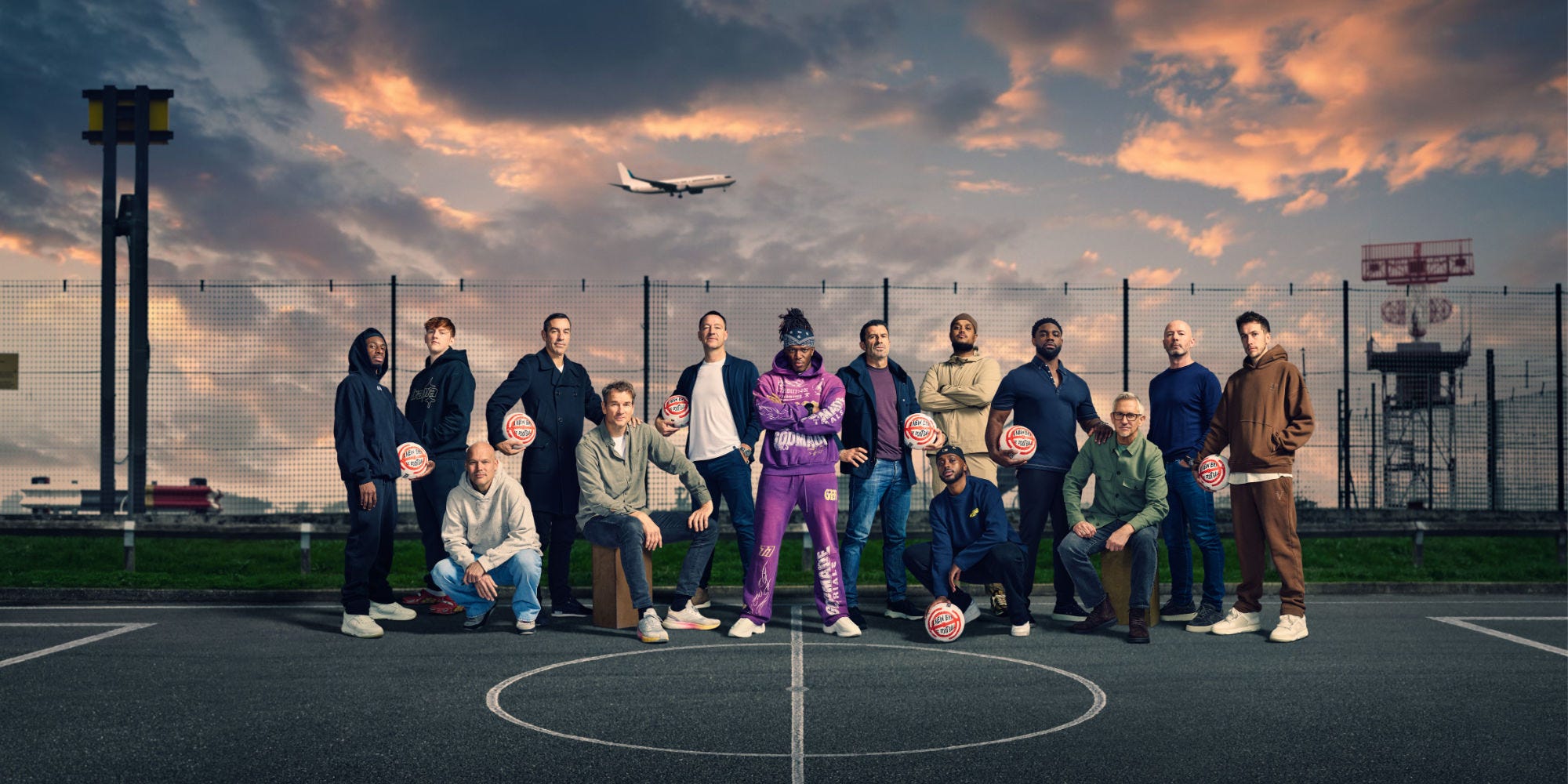
In the last decade or so, a clamour of voices has arisen around sports. They assert that sports the way they have been are losing relevance. Sports remain the last bastion of pure, unscripted fandom. But there have been numerous attempts to inject new energy, refresh and even reinvent certain sports. Any of us in the space or on its fringes, can’t ignore them.
In the frequent debates about the purity of sports versus the unabashed yet much needed commercialisation, lies a middle ground where exciting efforts are underway at making sports and entertainment come together in ways only these times can imagine. I plan to explore the space; last week my first piece from last week, on The Baller League coming up in March in the UK.
Add To Queue
-watchlist, playlist, readlist- :: stuff on my radar
Open Skies from Parikrama, an OG Indian rock band. A live instrumental performance from 2022’s Independence Rock, with some brilliant violin. · Spotify. Youtube ·
Se7en, the cult classic from David Fincher, popped up in my carousel because it is leaving Netflix soon. Glad to have pressed play, once more. What a film.
The Art of The Unkown on The Hidden Brain podcast. "Life is what happens to you while you're busy making other plans." · Apple Podcasts · Spotify ·
Masala Peanuts
(where I share stories or tidbits I find interesting).
Know: Thomson Reuters Wins First Major AI Copyright Case in the US. The decision could have big implications for the battle between generative AI companies and rights holders. Courts across the world are hearing claims by news outlets, authors, musicians and others who accuse technology firms of using their copyright work to train AI services. There are dozens of such cases in the US, as well as in UK, India, China, and other countries.
Watch: A charming laid-back interaction between two of the most talented creative icons reminds us that loud and fast need not always be the mantra (that’s Kendrick Lamar and Timothée Chalamet, by the way). They chat for Super Bowl Half Time show spot while riding around in a GNX. Have a look. There’s a part two where the two rap together, too!
Read: A Stanford student’s confessions on Tiktok, and a call for change. I secretly wished the TikTok ban had succeeded.
What does it say about us that we’ve become so dependent on an app that many of us secretly hoped someone would take the decision out of our hands? The failed ban represents more than just a chance to break free from digital dependence – it’s a mirror reflecting our collective inability to set boundaries with technology and assert agency in our choices.
The coffee might have some ice today!