

Edition #48
of Youtube villages, songologues, reality TV, a better internet, and drinking in our underwear
Greetings. I hope this Friday finds you in fine fettle.
Thank you for the responses and thoughts some of you have shared with me recently. I really appreciate those, and its always good to know that different aspects appeal to different readers, erm, differently. Please continue to ping; and talking of sharing- do spread the love if you feel you know someone who will enjoy these writings.
And on we go.
A Random Word : lets Finnish
Hamar Flix: A Youtube town in rural India
Friday Find: Songologues
An Internet Manifesto: Words for a better online life
Beast Games: Rich with reality, TV
With: Boy Love, Matrix meets Taika Waititi, and a confession on Tiktok and ‘Add to Queue’.
1. Random Word of the Week
I spoke some months ago about linguistic borrowing. Well, here is a borrowed word that somehow contrives to confound and delight at the same time, one that The New York Magazine said, “makes your sad weekend plans sound a little cooler”.
Presenting, "kalsarikännit", from Finnish.
Getting drunk at home in your underwear with no intention of going out.Oddly specific, but sometimes exactly what you need to say?
Its popularity a few years ago was in no small part attributed to the Finland Promotion Board’s collection of Finland emojis, for which I doff my hat to them. Here is a little guide on how to pronounce it.

If you are feeling a bit pedantic, you could read this gent railing on what it actually means, “Even though the term can be used to refer to that, it is not, strictly speaking, its meaning.”
In case you were still figuring what to do this weekend, well - thank me later :)
2. Hamar Flix
Do you know of the village of Tulsi, in the state of Chhattisgarh, in India? Me, I’d never heard of it.
In many ways, it's just another village, one of thousands in a sprawling country. A community of a few thousand people, where you’d expect life to move to the (familiar) rhythms of rural India. I could picture tea stalls and walks to school and the local panchayat. But Tulsi has written itself a different story. And found a different groove to move to.
In a village of 4,000, over a thousand residents are now entirely part of the digital content era. Videos created by Tulsi residents have made a mark on Youtube, shaping everyday lives into stories that resonate. This remarkable story began, as many might do, with two friends and a simple idea.
In 2018, Gyanendra Shukla, a former network engineer, and Jai Verma, a teacher, weren't trying to embark on some digital revolution. They were two friends whose YouTube channel struck a chord, with a couple of videos ‘going viral’. But it’s what this sparked, that’s fascinating.
Unlike much of how we might view the creator economy or the world of (largely urban) influencers, Tulsi's digital ‘awakening’ has been very communal. From the village now come around 40 YouTube channels, spanning everything from comedy to education. Even more fascinating- this growth crosses generations. From teenagers to the elderly, everyone has found a way to participate in this storytelling life.
Shukla & Verma’s channel, 'Being Chhattisgarhiya' was at the forefront of this transformation— going on to amass over 127,000 subscribers, and more than 260 million views for over 300 slice of life pieces. And they worked with other creators too-training, guiding, shaping.
They once received a call from an elderly patient who found laughter in their videos while at hospital. It spurred them to create more comedy stories. Today, the content across the channels from Tulsi ranges across skits and satires, traditional re-enactments, Chhattisgarhi music and Bollywood spoofs.
“The women, the elderly, and the children, all take an interest in our videos and support us. There are hundreds of YouTubers. We have all kinds of locations available… a railway station, a canal like river, greenery, jungle, colleges, schools, police stations. Every household in the village is part of our studio; just take permission and shoot.” -Jai Verma
Levelling Up.
Today many of the villagers earn a living off Youtube; it is not merely a fun diversion. Others have made a life they wouldn’t have even chanced upon a decade ago.
Pinky Sahoo went from dance videos on YT and IG reels, to acting in the Being Chhattisgarhiya videos, to being spotted by the regional film industry. She’s been in seven feature films now, and she’s not the only one finding new pathways.
Homemaker Ramkali Varma is a popular actor, often in gender issue pieces; Manoj Yadav had years on Youtube and now acts in movies; Aditya Bhagel started his channel while in college and today is Asst Director and Screenwriter for an upcoming big budget film.
“At first, our mothers and sisters were just helping out. Now, they're running their own channels. It's not something we would have imagined before. It is a serious business here, everyone participates.” -Rahul Varma
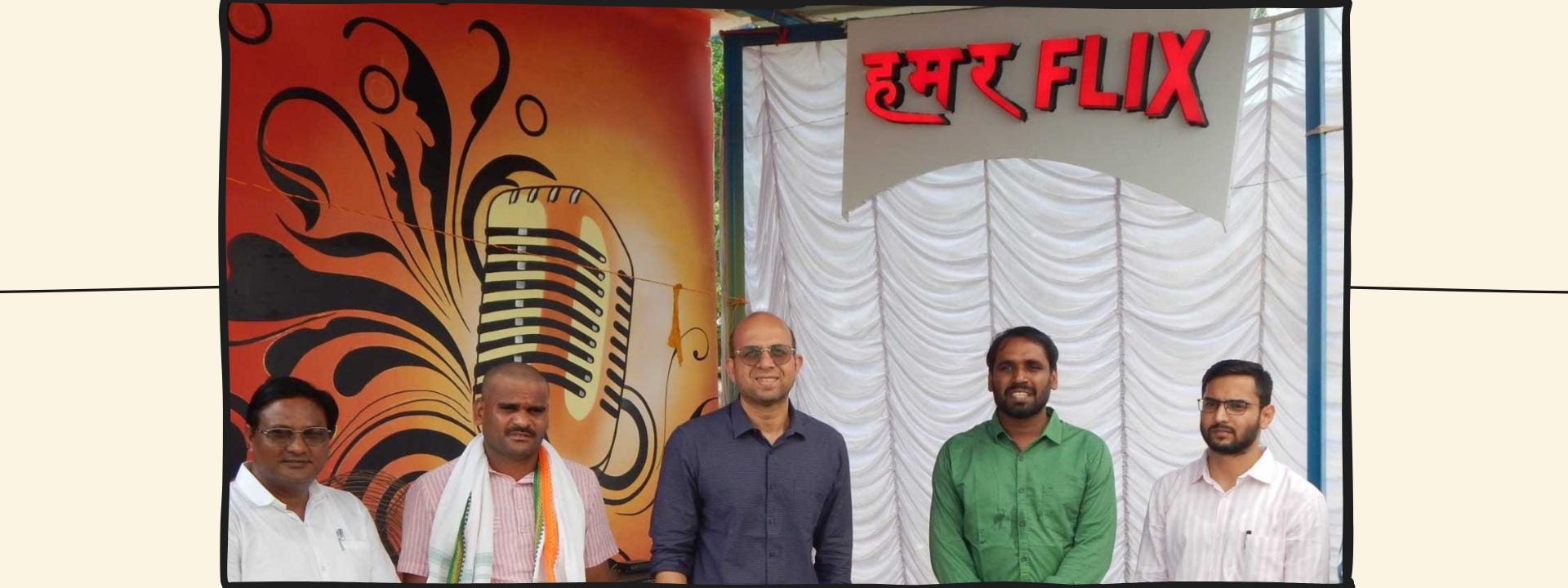
The other positive bit around Tulsi? The district administration got in on the action. Then Collector Sarvesh Bhure was “astonished” with the number of Youtubers, saying "I wanted to bridge the gap between rural and urban life by providing this studio. Their videos are impactful, with strong themes, and have reached millions. Setting up a studio was a way to motivate them." In 2023, the government invested ₹2.5m /₹25lakhs in a modern studio facility, which was duly christened ‘Hamar Flix’ (our flix). The studio defrays costs for aspiring creators, providing better equipment, and offering training.
“Everyone here participates. Women here are generally not allowed to step out of houses but through our YouTube channel, we have given them a lot of info that girls too can do something," -Pinki Sahu
I use that great, conveniently deployed and brutally overused term, “democratisation of content” rarely. In this case, it does seem apt. Narratives about rural life are often shaped by outsiders; here's a community wielding the pen for its own story. Tulsi is a little prompt for us us to remember technology's powers are not only in disrupting, breaking, redefining; but also in bringing together, sharing and preserving.
3. Friday Find: Songologues
Reels & Tiktok and social media in general get a lot of flak for doomscrolling and inundating us with unworthy content. It is a pity, because in that vast ocean are so many talented, insightful, funny, odd, charming creators and creations that could add a little something to our days. Today I wanted to share one such that I enjoy.
James McNicholas is a writer, a performer, a sports journalist, an actor (you might have spotted him in Ted Lasso), and author of a memoir, called The Champ & The Chump.
He writes on football for The Athletic and others, he did a much lauded solo show at Edinburgh few years ago, his book won some awards, and you might have spotted him in Ted Lasso. Since multi-hyphenates of this kind have a lot of spare time between the many things they are doing, James also puts out a series of little pieces on social media which he calls ‘Songologues’. Renditions very much his own, a bit theatrical, rather dramatic… just take a look, would you; a couple I fished out are here.
Many of us might have our own little relationship with song lyrics, I find James’ dalliance with them quite fascinating. And they’re not casual quickies either, there’s plenty effort that goes into these what with all the hair and makeup. There’s plenty more on his channel, and I find them to be worthy dramatic pauses in the scrolling life.
4. An Internet Manifesto
Buzzfeed recently announced plans to launch its own social media service. Wait, what?
Founder Jonah Peretti wants to focus on making the internet fun again (MIFA?). He talks of giving users agency- “built specifically to spread joy and enable playful creative expression.”
On the face of it, any intention that is focussed on more community and connections, and meant to help us escape from the big bad algorithms… is a worthy one; this is going to be “designed as an oasis from algorithm-driven doomscrolling”. But as with many intentions, the devil lies in the details- which we don’t have much of at the moment.
If the early internet was serving beer and wine that brought people together, today’s internet is dealing crack and fentanyl that tears people apart.
But wait. Let’s back up. There’s more to it.
In his post, called ‘The Anti-SNARF Manifesto’, Peretti passionately critiques the current state of internet content, and outlines his vision for a healthier digital environment. What is SNARF? His own snappy term, it stands for Stakes/ Novelty/ Anger/ Retention/ Fear- the kind of content that is a result of platforms not caring about content, only about the AI that can maximise usage.
Even for those of us with all the time and love for creators and the ‘democratisation of content’, we know this sounds painfully familiar.
“Content creators exaggerate stakes to make their content urgent and existential. They manufacture novelty and spin their content as unprecedented and unique. They manipulate anger to drive engagement via outrage. They hack retention by withholding information and promising a payoff at the end of a video. And they provoke fear to make people focus with urgency on their content. Every piece of content faces ruthless Darwinian competition so only SNARF has the ability to be successful, even if it is inaccurate, hateful, fake, ethically dubious, and intellectually suspect.”
Content Doesn’t Matter.
Peretti believes that this started with Tiktok. Not one to waffle, he recalls a 2017 meeting with Bytedance founder Zhang Yiming. “He explained to me that he wanted to launch an app in the US, but he needed a source of video content. I asked what kind of content and he said it didn’t matter, he just needed tens of thousands of videos each day. He explained that [his AI was] so good that the content didn’t matter. He just needed raw tonnage of content so the AI could create a personalised experience and get the flywheel going.“
He paints Zuckerberg in a similar light, claiming that he too, similarly, “doesn’t care very much about the content on his platforms and is much more interested in technology and AI.”
The SNARF he speaks of is hard for many of us to deny, despite however much fine, meaningful content also exists on the internet. Whether as writers, creators, readers or watchers, we all have felt sometimes that we are merely ‘consumers’. And it is not just our content consumption that is affected in some entertainment bubble. Much of our discourse and culture is shaped by these highly controlled (and out of control) content engines; “downstream from big tech’s global SNARF machines.”
Reading his post also nudges one to a 2024 study by the National Bureau of Economic Research (US), which found that many social media platforms generate negative externalities— a take that the likes of CHT have spoken often and eloquently about. Strikingly, a majority of respondents said they would prefer a world without IG & Tiktok. Yet, we continue to engage, despite perceived and real negative impacts.
The report raises the question- whether companies introduce features that are increasing people’s need for a product without increasing the utility it delivers to them.
Of course, all of this leads us to what he believes Buzzfeed is looking to do (must do)- create content that actively avoids the SNARF traps, “great stories that keep people engaged, without annoying retention hacks”, and “human curation of the best of the internet, providing an alternative to algorithmically recommended SNARF.”
Peretti has obviously had a storied journey in digital media, building a website that was at the heart of the zeitgeist for many years. It has been a chequered trajectory in recent years though, and Buzzfeed’s struggles have been equally storied. How that combined DNA will give rise to a more ‘pure’ social media is very much an open question. If I sound cynical, I do not mean to- as I said, good intentions in this space are very welcome indeed. Peretti is excited "after years of being beholden to other platforms".
We shall wait.
· the post ·
5. Beast Games
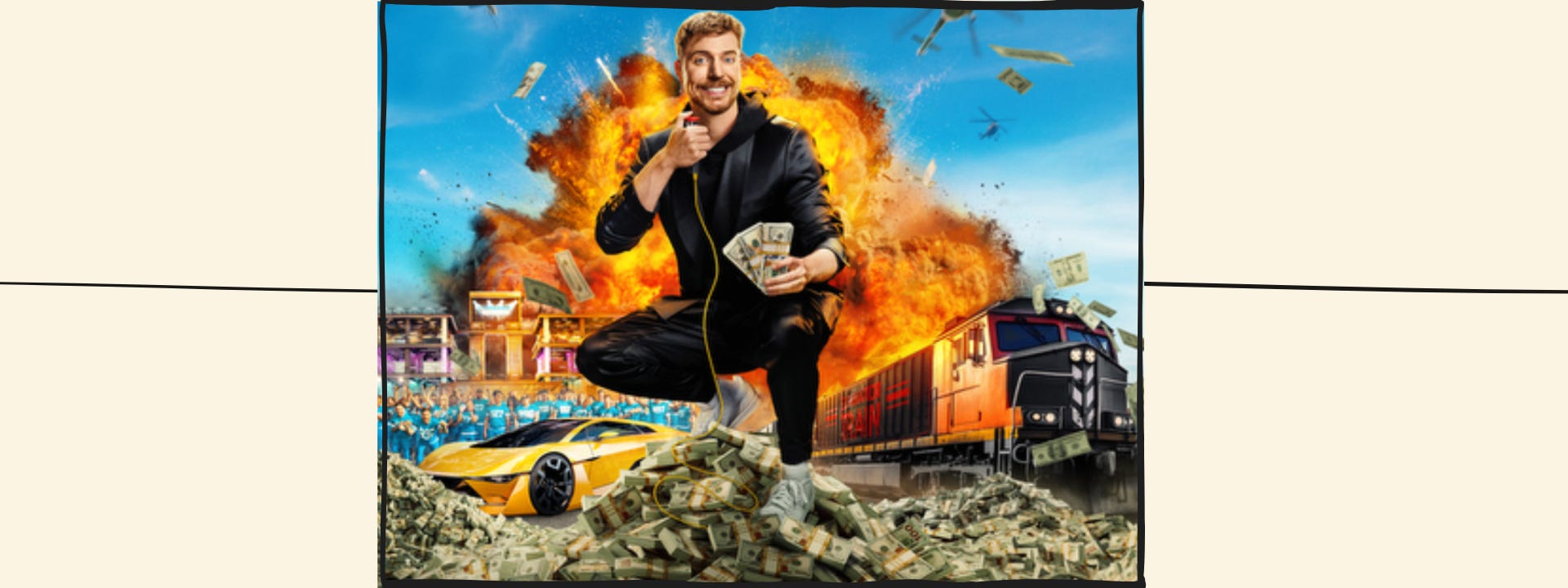
If you have not heard of Jimmy Donaldson, you have heard of MrBeast, and they are one and the same. The biggest Youtuber on the planet was roped in by Amazon Prime Video a year or so ago, to build a splashy new reality show for the streamer. The idea was for him to get his particular brand of content into a ‘mainstream’ platform. It was a huge deal, with the show reportedly costing in the region of $100m; it was also huge because this was not just some content creator shaking hands with a cable or streaming service, this was MrBeast.
He shared much ambition around the show when it was announced. That, combined with his staggering 360+m followers and 72billion views on Youtube since 2012 (at time of writing), set this up for a show that must surely break through— both statistically and culturally.
So Beast Games finished its run on Amazon Prime Video last week. Disclaimer- I have not watched the entire season. At any rate, here's my take.
I get it- reality TV is driven largely by two things- the payoff at stake, and the (constructed) emotions. Mr Beast’s Youtube content is also often predicated on the scale of the giveaways, the $ involved. So one should go into Beast Games expecting much of the same.
Staggering prize monies are great— in this case US$5m for the winner, with plenty else offered along the way— but the loud, unabashed focus on money at every possible stage of an episode, really started to put me off. The incessant high decibel level around the dollar value at stake, shouted out literally every few minutes, was a bit much.
I’ll be honest, I found it crass.
Some of the psychology around the games was undeniably interesting, even riveting in patches, but the games themselves seemed crude vehicles to put people into cash-grab situations, or to test some sense of ‘morality’. There’s a gratuitous use of ‘self-sacrifice’ mechanics, and leveraging the ensuing (overblown) disappointment or shock or anger as entertainment.
I wrote about the show last year soon after it was announced; I noted (but was not surprised) by the level of hyperbole. “The biggest ever”, “things you haven‘t seen before”, “a different animal than anything anyone has ever done”. Besides the highest prize money (and some impressive scale), I am unclear what the show has done that is truly ground-breaking.
Also- major Squid Game vibes, Jimmy?!
Add To Queue
-watchlist, playlist, readlist- :: stuff on my radar
The Succession Score by Nicholas Brittel, one of the finest scores from TV in the last many years, has had its own deep contribution to the show; it often makes for good music for writing.
The Legend of Sally Jones, a children’s graphic novel is an oddly charming, moving and lovely story told with kindness and emotion- about a gorilla called Sally Jones.
Masala Peanuts
(where I share stories or tidbits I find interesting).
Read: BL or Boy Love originated in Japan in the 1970s; but when Thai production firms recognised the genre’s screen-worthy potential, combining manga plots with sleek aesthetics, it took off. The Economist looks at the Boy Love and Girl Love interest, in “Fans are going crazy for Thai television shows and music”
Watch: The Matrix meets Taika Waititi meets Keegan-Michael Key meets rabbit holes, with Trinity. And oh, eating Lays. Pretty cool how a movie released nearly 26 years ago still has cultural resonance. It does, right?
Watch: Grand Theft Hamlet seems an utterly weird and absorbing semi-documentary, about a couple of folks who— during the pandemic— set out to make a production of Hamlet in the multiplayer online game Grand Theft Auto. Variously called “poignantly hilarious”, “a fresh dose of grotesquerie” and “murderously funny”. Trailer
Till next time!
Haha yeah. Not high score for originality but it’s fun
Hamar flix :)
Love it!!