

Artificial and Real Creativity
Coppola’s AI misadventure. A boxing tour de force. Artistically Artificial.
Namaste. Thanks for opening this week’s missive. As always, I would love it if you share thoughts, feedback, bouquets and brandy about what you read here!
Creative Infection: How Francis Ford Coppola collided with AI.
Friday Find: Everything or Nothing, a video with a punch.
Artistically AI: A debate on AI’s role in making Art.
With: Indian AAA games? Medieval music? Sexual fantasies?
1. Creative Infection
Maybe you consider The Godfather a “sloppy, self-indulgent movie”? Or Apocalypse Now “an epic piece of trash”?
Or maybe not.
Francis Ford Coppola’s latest epic- a decade or more in the making- is almost upon us. The official trailer for Megalopolis dropped late August. And with it, we now officially have a trailer from a major studio… that has been infected by AI.
Here’s what went down.
Early reactions from the film’s Cannes premiere were underwhelming. In a potentially savvy marketing move, the team at Lionsgate turned to a reliable tactic- leverage negative reviews to build impact. The trailer led with disparaging quotes from reviews of FFC’s previous iconic films. The contrast, with Lawrence Fishburne’s imperious voice, suggested to viewers that the legendary filmmaker’s latest would also become a classic.
But.
In 24 hours, the trailer was yanked off the net.
Gotcha!
I happened to see this spot the very day it released, and it included strikingly jarring quotes like, “sloppy, self-indulgent movie” (Godfather) and “an epic piece of trash” (Apocalypse Now). Strangely compelling as it was to see a spot peppered with such quotes, I got the point, as the piece went into showcasing the director’s new vision.
Turns out, none of the negative reviews were real.
Reports like this one from The Vulture questioned the trailer, and soon the studio had to say, “Lionsgate is immediately recalling our trailer for Megalopolis. We offer our sincere apologies to the critics involved and to Francis Ford Coppola and American Zoetrope for this inexcusable error in our vetting process. We screwed up. We are sorry.”
But it gets better (worse?). It was most likely not a loose cannon scriptwriter who just made them up for ‘creative effect’. It appears it was AI that offered them up to the researcher/writer, from where they found their way to a trailer that was, amazingly, seen and re-seen and vetted, and still approved by many in the chain.
This whole things seems both entirely avoidable and entirely inevitable.
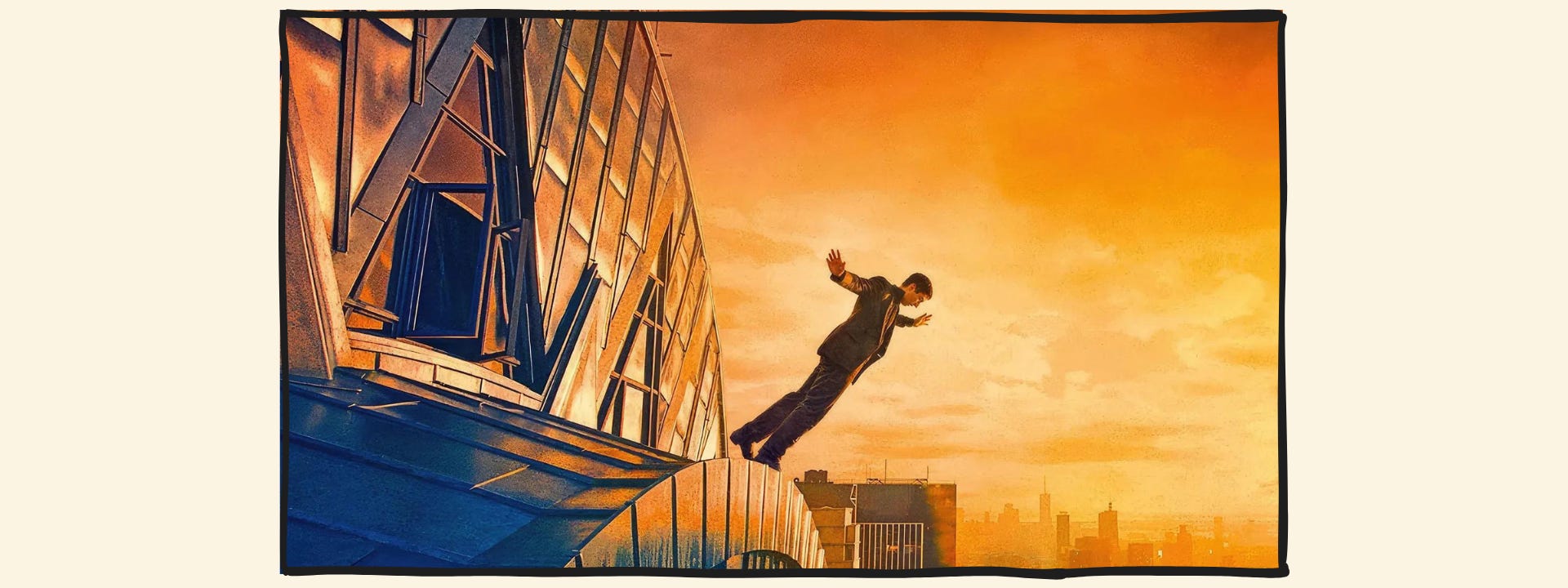
Lets say (simplistically), the use of AI here was meant simply to make things efficient. It saved the time and the rigour of having to search and read the many, many reviews of FFC’s iconic filmography over the decades, then sift out the stray quotes that could serve this creative idea. I personally have literally been there- as a writer and producer/director for promos and trailers, I’ve gone down the trusty ‘quotes’ route- often reading twenty, thirty pieces, community boards, comments sections for a show or movie (or sporting encounter), just to find those few special words to enrich the message. The idea that someone or something could do this for me in the matter of minutes is terribly appealing! But for anyone interested in being credible, you then vet the information. In this case, it would mean looking for each of those quotes, to ensure they had actually been said, and said in the correct context. I see this as basic due diligence, not some elevated ‘journalistic’ rigour.
The thing is, carrying out this basic but tedious rigour is almost as much as just doing the damn thing yourself.
I do use AI for some tasks, find it useful, often a time-saver. But there is nowhere near enough credibility in these tools right now to blindly take their information at face value. Any of us choosing to use them cannot do so without understanding the potential pitfalls. This is merely a high-profile case which should serve as a prime example to those who believe Generative AI is a silver bullet to marketing and creative needs.
~ · ~
*Self-financed by Coppola at a budget north of $100M, Megalopolis is a Roman epic set in an imagined Modern America, starring Adam Driver, and is his first feature since 2011. Here’s the official trailer, V2.
2. Friday Find: Everything or Nothing
Boxing advertising can be quite powerful, often because of its sheer rawness. Here’s one that stylistically builds a larger narrative around its protagonists (the fighters), giving us a very real glimpse of who they are and how they got here- from Omaha 1995 and Khiva 2003, to LA 2024.
The conceit is not unusual, building the two fighters as men whose entire lives have led to this moment. But the treatment builds it with great craft, taking us through humble childhood bedrooms and kitchens and streets, sweat-drenched gyms, train rides and many introspective moments. Director Rich Hall’s approach of using the four sides of the ring as windows into their lives makes for a captivating piece, really more a little short film than mere promo.
The haunting song Trøllabundin is from Eivør's Faroese album Slør released in 2015.
[ I had to check on Faroese. The language of the Faroe Islands, it has just around 50,000 native speakers. Its a North Germanic language, remarkably similar to Icelandic. For about 300 years from the 16th-19th centuries the Danes outlawed the use of Faroese in official writing, so it was a purely oral language until an alphabet was created for it in 1846. ]
*Terence Crawford went on to win the fight and become a four-division champion.
· Director Rich Hall with Riff Raff Films ·
· Editor Ben Corfield / Stitch · Music Supervision The Hogan · Sound Design 750mph ·
3. Artistically AI
Ted Chiang is one of the most celebrated science-fiction writers we have, and also an acclaimed thinker on technology and AI. He was on Time's ‘100 most influential people in AI’ list in 2023.
Always erudite and thoughtful on how technology and humanity interact & collide, he recently weighed in on generative AI and its place in what we might call art, with his piece in The New Yorker, “Why A.I. Isn’t Going to Make Art”.
Chiang’s is not the sort of writing that can be reduced to pithy bullet points or insightful posts, so I share here some of what resonated, and recommend you read the full piece.
He makes the case for how Art it is connected to human expression & interaction, and where AI lies in this nebulous space. Chiang breaks down most art as a series of choices, often thousands of them. They are made by us, humans, and are the result of our layered experiences. What choices does an image generator or AI writing tool make? Where are the intersection points?
His deeply human take on science and technology (in his essays as well as his fiction), unsurprisingly lead him to say:
The task that generative A.I. has been most successful at is lowering our expectations, both of the things we read and of ourselves when we write anything for others to read. It is a fundamentally dehumanizing technology because it treats us as less than what we are: creators and apprehenders of meaning. It reduces the amount of intention in the world.
A compelling take, though not definitive because its very much in the context of art (not commerce or mass advertising which is where a lot of the generative AI output is primed to make a mark).
But Its Real.
I read his piece last weekend. Not long after, I saw Matteo Wong respond to Ted Chiang, with an equally thought provoking piece in The Atlantic. His rebuttal is predicated on Chiang’s presentation of art as a function of human toil, which Wong refutes.
The key takeaway for me from Chiang’s piece is two fold- intention and experience. Our art is a culmination of our life experiences, and the intention to use our perspectives to create/ communicate with the world around us.
Wong believes the role of intentionality too, can be overstated, and risks reducing the scope and appreciation of human creativity. Overall, he makes the point that we should not look at binaries in this debate. (Its a recurring theme in my thoughts on generative AI, and in much commentary around it).
There isn’t a binary between asking a model for a complete output and sweating long hours before a blank page or canvas. AI could help iterate at many stages of the creative process… How a model connects words, images, and knowledge bases across space and time could be the subject of art, even a medium in itself.
He finishes with this,
Chiang’s essay, in a sense, frames art not just as a final object but also as a process. “The fact that you’re the one who is saying it, the fact that it derives from your unique life experience and arrives at a particular moment in the life of whoever is seeing your work, is what makes [art] new.” I agree, and would go a step further: The processes through which art arises are not limited and cannot be delimited by a single artist or viewer but involve societies and industries and, yes, technologies. Surely, humans are creative enough to make and even desire a space for generative AI in that.
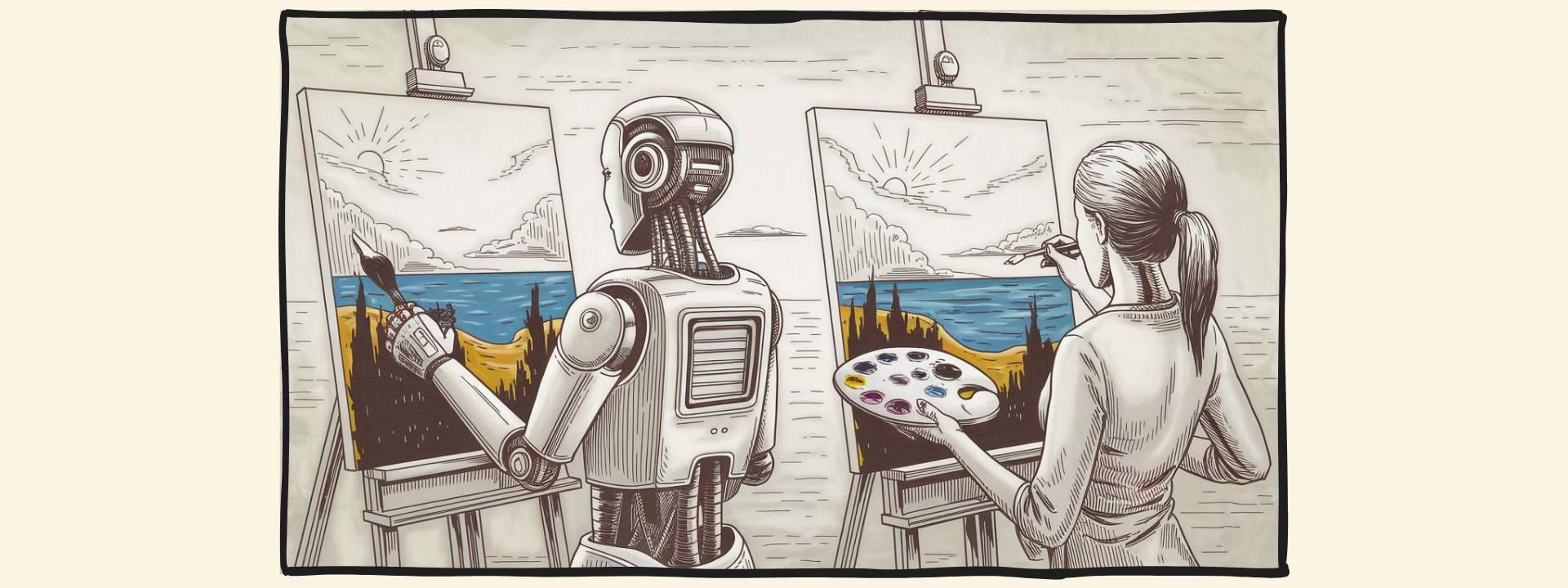
Like we struggle to define Art, we will continue to debate areas like this one, wading through the greys that this transformative new space constantly paints for us. As with much around AI, I am constantly reminded of my belief in these times- eventually, it is our humanity that will shine through. It is our own expressions and living that we must be led by. To that, I leave you with this from Chiang’s piece- the very bit Wong quotes in his conclusion, and the bit I found most evocative.
What you create doesn’t have to be utterly unlike every prior piece of art in human history to be valuable; the fact that you’re the one who is saying it, the fact that it derives from your unique life experience and arrives at a particular moment in the life of whoever is seeing your work, is what makes it new. We are all products of what has come before us, but it’s by living our lives in interaction with others that we bring meaning into the world.
~ · ~
Links:
Why A.I. Isn’t Going to Make Art - Ted Chiang
Ted Chiang is wrong about AI Art - Matteo Wong
Related: We’re Witnessing the Birth of a New Artistic Medium - Stephen Marche
4. Peanut Masala
(where I share stories or tidbits I find interesting)
Know. ‘The Age of Bharat’, a fantasy gaming franchise set in ancient India, was announced. Some very capable folks have come together for this, with the ambition of releasing a AAA game in 2026. “‘Bharatvarsha’ will not only showcase the mainstream potential of Indian stories in video games but also serve as a gateway to the nation’s rich mythology for a global audience.”
Read. Want is a 21st Century take on women’s sexual fantasies, edited by Gillian Andersen, now associated with frank discussions about intimate activities after her role as a sex therapist in the hit Netflix show Sex Education. “Anderson says she was “surprised” how much shame there still is around talking about sex and sharing sexual fantasies with friends or partners.” Here’s an interview with the actor, who first made her mark as Dana Scully in the TV show The X Files.
Buy. A medieval themed synth. Unless you don’t want a medieval themed synth. This is the “world’s first medieval electronic instrument”, featuring ‘hurdy gurdys, lutes, Gregorian chants, thundering drums and punishing percussive foley FX’. Stumbled on to via this piece about ‘the ancient and otherworldly charm of Future Medieval graphics’.
Off for my brew!